Serenity 10.7.0 Release Notes (2026-11-17)
These release notes detail the changes made in Serenity and StartSharp from version 10.6.2 to 10.7.0. For a complete list of changes, please refer to the Serenity Change Log.
This is the largest release since 10.6.0 and it has four big themes:
- Dashboards (Enterprise):
Serenity.Pro.Dashboardsships. Users design dashboards in the browser, over data sources that are configured, permissioned and rewritten for the target database. - Server-calculated data: list requests can now ask for aggregates, group-by and "entities excluded", so grids show correct totals, group totals and counts without loading every row. Date fields can be grouped by intervals (year, quarter, month, week, day, hour) in the user's time zone.
- One validation model: the rules a property declares are enforced both in the browser and in save handlers, with the same attributes, the same messages and the same client-side rule classes.
- A build and asset pipeline you don't have to think about: project and package
wwwrootfiles are served without the .NET static web assets SDK, types can be lazily loaded in groups, and code generation, TypeScript compilation and packaging became incremental.
Along the way there are new editors (ColorEditor, DateRangeEditor), conditional form fields (VisibleWhen / ReadOnlyWhen / RequiredWhen), infinite and virtual scrolling views, StringEnum, inferred form/column/enum keys, attribute inheritance from interfaces, the released Serenity.Testing and Serenity.Testing.Playwright packages, and a lot of localization and SQL fixes.
10.6.3 was a patch release between 10.6.2 and 10.7.0. It only pins the TypeScript 7 compiler for new projects, fixes a false warning in sergen doctor, bumps packages and reorganizes the packaging scripts, so nothing there requires application code changes. It is covered in its own section below.
Serenity.Pro.Dashboards (Enterprise)
Serenity.Pro.Dashboards lets authorized users build interactive dashboards in the browser, on top of the data of the application, without writing code or redeploying. It consists of two modules:
- Dashboards (
Serenity.Pro.Dashboards): the designer and the viewer, with widgets on a grid, filters in the toolbar, click actions, translations and per-dashboard permissions. - DataSources (
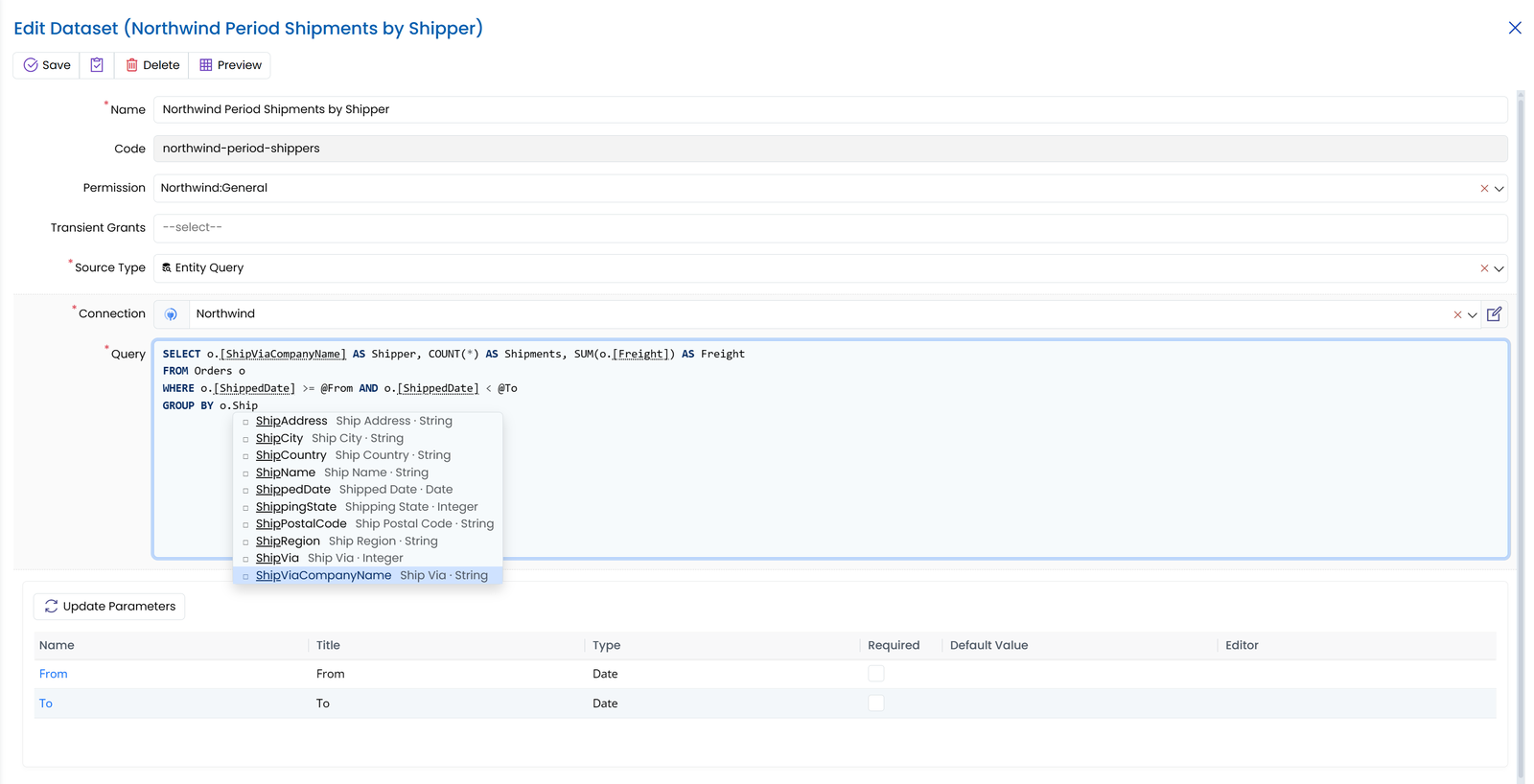
Serenity.Pro.DataSources): the data layer. It defines connections and datasets, which are named, reusable queries that run with the permissions of the viewer.
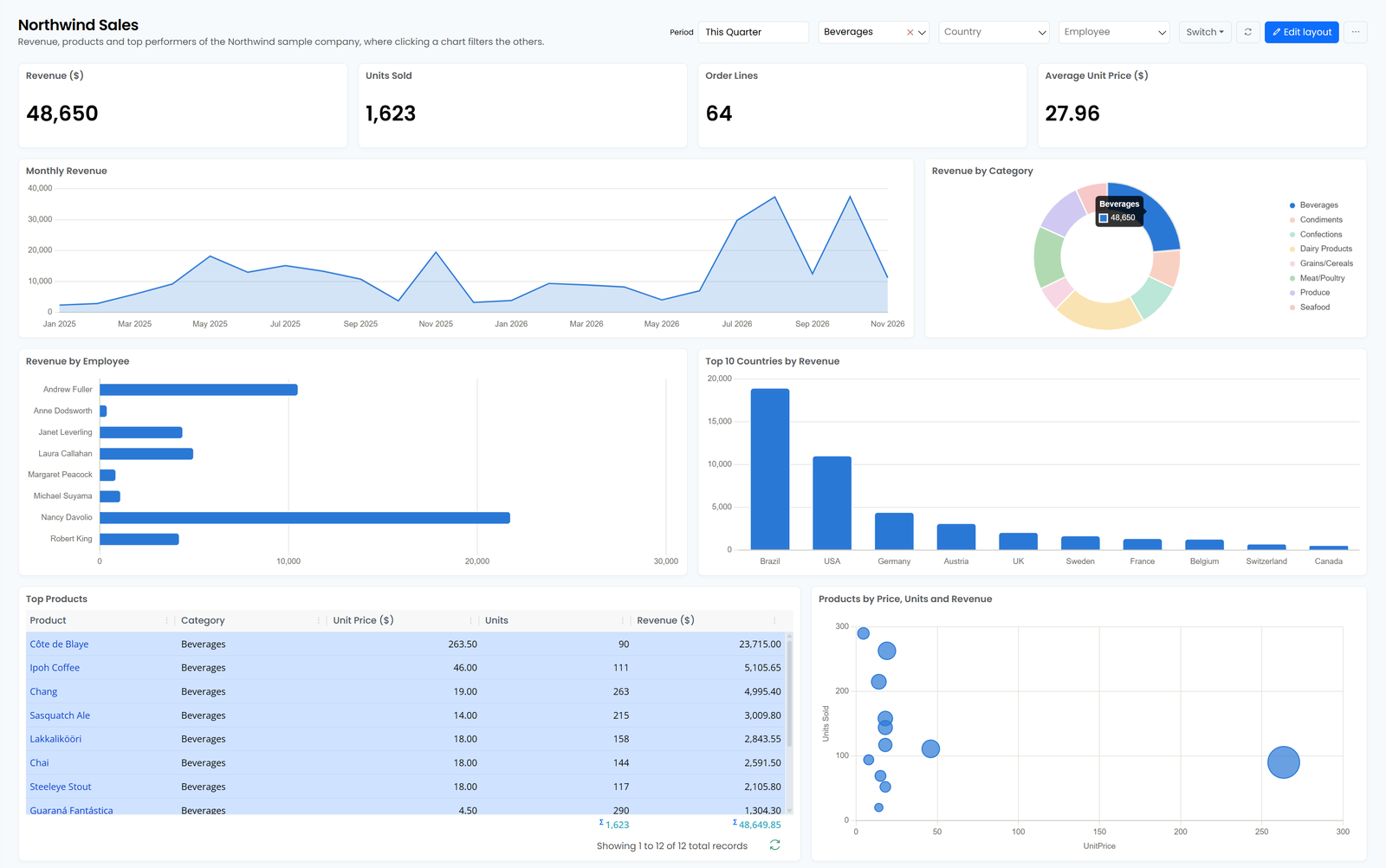
Widgets include charts (line, area, bar, pie, doughnut, polar area, radar, scatter, bubble) with configurable series and trends, number cards with server aggregates, tables with virtual or infinite scroll, gauges, funnels, lists, activity feeds, Markdown text and links. Widget properties and table columns can be edited in the designer, including from the grid header.
Aggregation happens in the database: sum, count, distinct count, average, minimum and maximum, with dates grouped by hour, day, week, month, quarter or year and "top groups" limits. Datasets can come from entities, entity queries, tables and views, SQL queries, list services and JSON, and their parameters can be fixed, bound to a dashboard filter, or asked for on the widget itself.
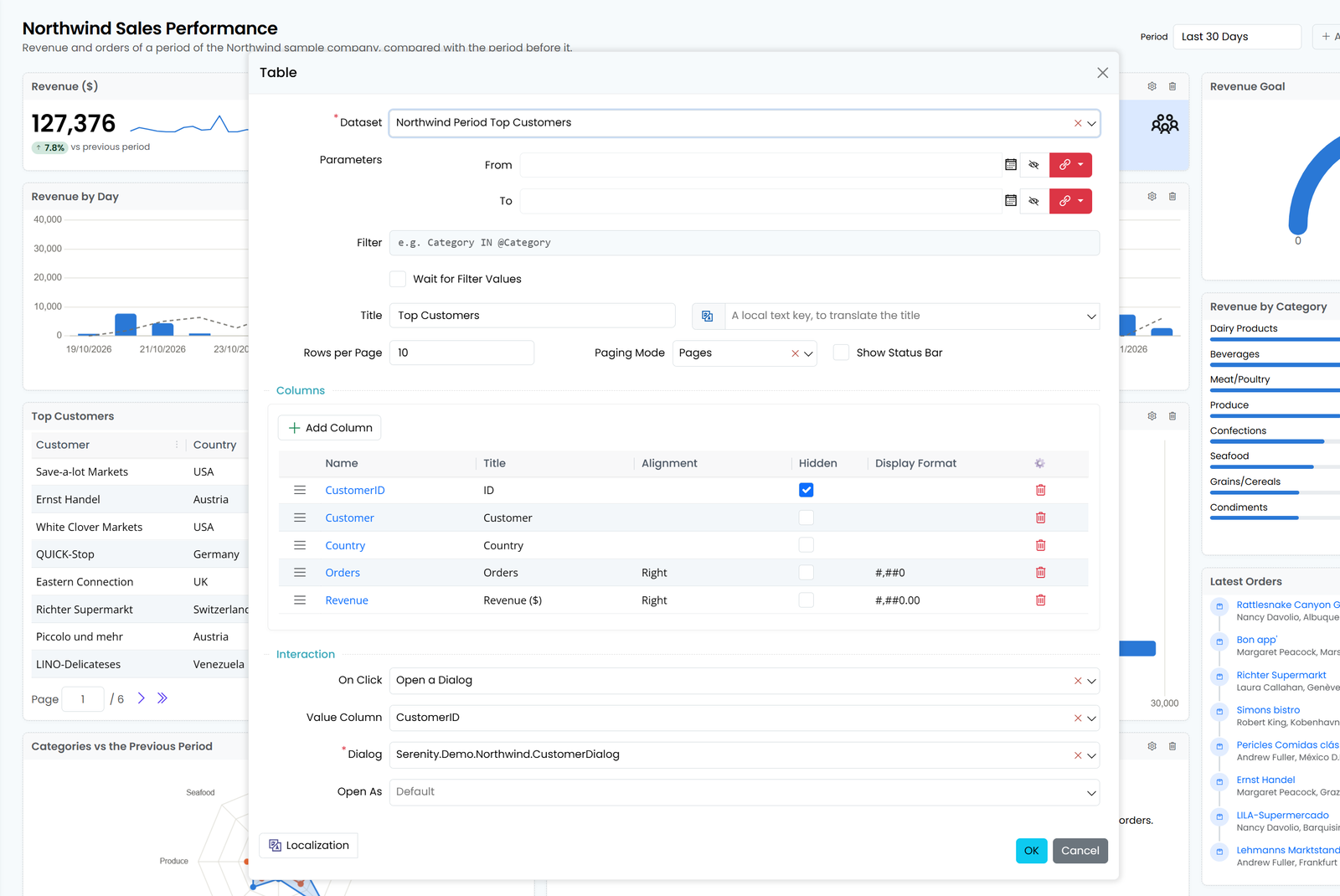
Dashboard filters are kept in the page address (?f.Category=Beverages), so a dashboard is linkable and reloadable. A widget's filter expression is a clause such as OrderDate >= @Period.Start AND Category IN @Category, and a clause whose filter is empty is dropped. Click actions can set a filter, open a link (for example another dashboard with its filters set) or open an entity dialog. Datasets are resolved per widget, widget errors are isolated in place, and dashboards are versioned with save-conflict handling. Dashboard, menu and widget texts are localizable and stored with the dashboard, so it can be copied to another server with its translations.
Dashboards can appear in the navigation menu, and the home page can display one for everyone, for some roles or users, or as each user's own choice:
[PageAuthorize, HttpGet, Route("~/")]
public async Task<ActionResult> Index([FromServices] IDefaultDashboardSelector dashboardSelector,
    CancellationToken cancellationToken = default)
{
    if (await dashboardSelector.SelectAsync(cancellationToken) is { } dashboard)
        return await this.DashboardViewAsync(dashboard, cancellationToken);

    return View(MVC.Views.Common.Dashboard.DashboardIndex, new DashboardPageModel());
}
Dashboards can also be used as templates, with a browse page that previews them, and each dashboard can have its own navigation icon.
Nothing Is Reachable Until It Is Configured
A connection is only usable when it is listed in DataSources:SqlDataConnector, and entities, tables and views are each off until their permission is set:
{
  "DataSources": {
    "SqlDataConnector": {
      "MaxRows": 10000,
      "CommandTimeout": 30,
      "ConnectionKeys": {
        "Northwind": {
          "Permission": "Northwind:General",
          "Entities": { "Permission": "Northwind:General" },
          "Tables": {
            "Permission": "Administration:General",
            "Rules": [
              { "Deny": "dbo.Customers(Phone, Fax)" },
              { "Filter": "dbo.Orders", "Where": "EmployeeID = CURRENT_USER_ID", "UnlessPermission": "Northwind:AllOrders" }
            ]
          }
        }
      }
    }
  }
}
ConnectionKeysare the only connections datasets may use. An entry can also give its ownConnectionStringandProviderName, e.g. a read-only login to the same database.Entitieslets datasets read application entities through their list handlers, so the filters and field permissions of the application apply.DefaultModulepicks the module of an ambiguous name.Tableslets datasets read tables and views directly and write SQL over them. Anyone with this permission can read rows without the entity filters, so grant it carefully.Rulesdecide which tables, views and columns can be used:Allow(optionally with aPermission),Deny(always wins, except forUnlessPermission),Protect(unusable through wildcards, only an exactAllowmakes it usable) andFilter+Where(row filters that also apply inside joins). A target isschema.objectorschema.object(column, ...), with*wildcards, andWhereconditions can useCURRENT_USER/CURRENT_USER_ID.- Default rules allow every table (
*.*) but protect the sensitive tables of the application (users, roles, mail, audit log, data sources, dashboards, ...) and columns named like Password, PasswordHash, Secret, ApiKey, AccessToken or ConnectionString. SetUseDefaultProtectRules/UseDefaultAllowRulestofalseto supply your own list.
Datasets run with the permissions of the viewer, not of the designer. SQL written in a dataset is never sent to the database as is: it is parsed, checked against the access rules and rewritten for the target database with every value as a parameter, and only SELECT queries are possible. A dataset that has to show data its viewers can't read directly (for example grand totals) can be given transient grants, which require DataSources:TransientGranting plus every granted permission. Filter expressions sent from the browser can't contain subqueries or functions.
Data Sources in Your Entities
How an entity may be read as a query source is declared with [EntityQuery]:
| Mode | Behavior |
|---|---|
ListHandler (default) |
Through the query of its list handler, with all its filters. A handler that drops rows after its query is refused unless the row explicitly confirms this mode. |
Behaviors |
Through a generic list handler with the list behaviors of the entity. |
Unfiltered |
From its table and joins, with its permissions but without list handler filters. Never use it for rows that must be filtered, e.g. multi-tenant ones. |
Disabled |
The entity can't be used by datasets. |
List services can be used as datasets too, configured by DataSources:ListService (IncludeRoutesRegex, ExcludeRoutesRegex, MaxCallsPerRequest). They run in-process through the full ASP.NET Core pipeline, with the authorization of the current user.
Template Integration (StartSharp)
- The
Dashboardsfeature is now Enterprise only (it is no longer part of the Business edition) and is enabled by default in the StartSharp VS templates, next to a newTwoFactorAuthenticatoroption. EnterprisePackagesEnabledis gone:Serenity.Pro.Dashboardsis always part of the package catalog and is checked for already-published versions, since it actually ships.- The template's
appsettings.jsongets aDataSources/SqlDataConnectorblock gated by theDashboardsoption, which registers the Northwind connection key and itsNorthwind:Generalentity permission when theNorthwindoption is selected. - The Northwind sales dashboard and its sample datasets are migrations tagged
[SampleData("Dashboards")], so they only run when that sample data is requested, e.g. in the public demo. The feature's tables are nameddash_*(dashboards) anddsrc_*(data sources), and they were added to Data Explorer's default exclusions since they are internal.
Because dashboards add navigation items at runtime, the navigation cache has to depend on the item group key so the menu updates without waiting for a cache expiration or a restart:
Items = cache.GetLocalStoreOnly("LeftNavigationModel:NavigationItems:" +
    (userAccessor.User?.GetIdentifier() ?? "-1"),
    TimeSpan.Zero,
    [UserPermissionRow.Fields.GenerationKey, NavigationCaching.ItemsGroupKey],
    () => NavigationHelper.GetNavigationItems(permissions, typeSource, serviceProvider,
        url => ToAbsolute(url)!))!
Custom widgets are a C# options class marked [DashboardWidgetType("<client class key>")] plus a client widget registered with that key; widgets in other bundles can be loaded on demand with LazyLoadInclude. Custom variables (e.g. CURRENT_TENANT_ID, which must start with CURRENT_) are registered through IDataVariableProvider.
Server-Side Aggregates and Grouping
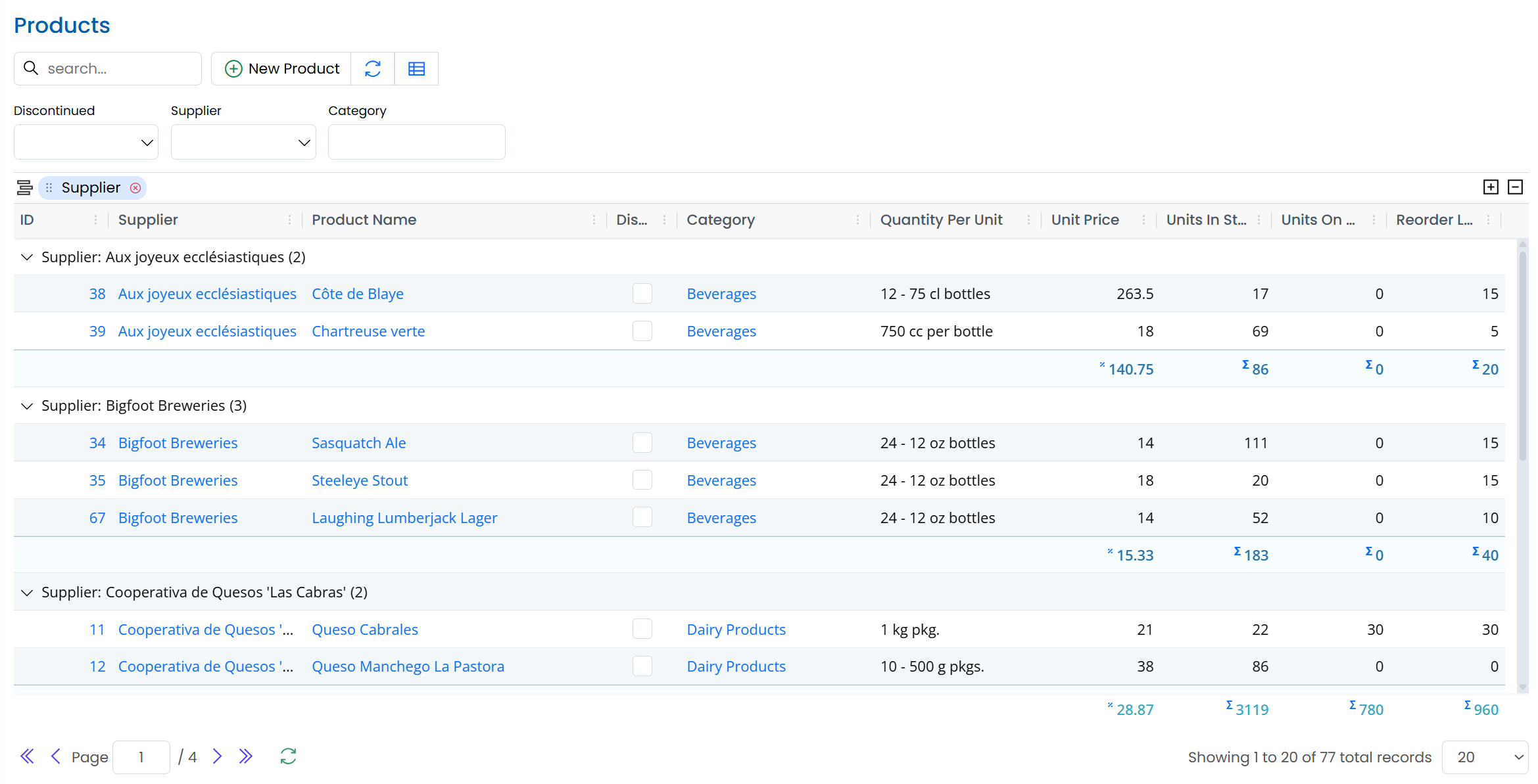
Until now a grid could only show totals for the rows it had loaded: the footer of the grid, and the totals of a grouping, reflected the current page. On large tables they were therefore misleading, and asking the server for a sum meant writing a custom service.
ListRequest now carries the calculation itself:
public class ListRequest
{
    public List<AggregateBy>? Aggregates { get; set; }
    public List<GroupBy>? GroupBy { get; set; }
    public bool ExcludeEntities { get; set; }
    public string? TimeZone { get; set; }
    // ...
}
AggregateByis a field plus anAggregateType(Sum,Avg,Min,Max,Count,DistinctCount), andAggregateBy(null, AggregateType.Count)counts the rows.GroupByis a field, an optionalDescendingflag and an optionalInterval, and groups are nested, the outermost first.AggregateGroup.Moretells that a level has more groups than returned.ExcludeEntitiesasks only for the count and the aggregates: the handler reads a single row and clears the entities.TimeZone(an IANA name likeEurope/Istanbul, or a Windows one) tells where the days start for interval grouping, so UTC dates are grouped by the days the user sees. Filters and returned dates are unaffected. An unknown zone throwsValidationError("InvalidTimeZone").
Handlers declare what they support with new ListRequestCapabilities values, so a client can detect support before asking:
| Capability set | Contains |
|---|---|
ListHandler |
The baseline list handler, currently the same as Baseline (filtering, sorting, paging, columns, distinct, localization, IncludeMore, ExcludeEntities) |
ProListHandler |
ListHandler + AggregateOptions (Aggregates, GroupBy, ExcludeEntities, TimeZone) |
SourceAdapter |
The in-memory source adapter, which supports all of the above |
The base ListRequestHandler itself only honors ExcludeEntities. Aggregates, grouping and time zones are filled in by ListAggregatesBehavior in Serenity.Pro.Extensions (or by a list source adapter that supports them), so a Serene project without pro features ignores those request options and grids keep calculating totals from the loaded page.
How It Is Calculated
ListAggregatesBehavior runs after the filtering behaviors, so it counts what the user is allowed to see, and uses a single ROLLUP query for all group levels on SQL Server, PostgreSQL, Oracle and MySQL (per-level queries elsewhere). It sets TotalCount and More from the totals query and clears CountRecords on the list query, so rows are not counted twice. Each level is capped at MaxGroupsPerLevel; fields are validated against the selectable/readable fields, grouping is dropped when a group field is not allowed, and sums/averages over non-numeric fields are skipped.
Date intervals are translated per dialect with weeks starting on Monday, and time zone conversion is generated for SQL Server, PostgreSQL, Oracle, MySQL, Firebird and SQLite (named zone conversion where the dialect has it, a fixed current-offset fallback otherwise, with the DST limitation documented). When the target source does not support them, aggregates and intervals are mirrored by ListRequestLocalAggregates in the in-memory source adapter: totals are computed from all matching items before paging, and entities are dropped afterwards when ExcludeEntities is requested.
IListResponse members are now settable, so a behavior that has already counted the rows can supply TotalCount / More directly and avoid a second count. ListResponse<T>.Entities has an explicit setter that converts any assigned IList into a List<T>. SummaryType and AggregateType members now have localized texts, and AggregateType numbers are aligned with the matching SummaryType values so the two enums map to each other.
In the Browser
RemoteView gained a serverAggregates option: it asks the server for grand totals and per-group totals/counts, and falls back to the page rows when the server returns none, when the aggregator is unsupported, or when a local filter hides rows. It reloads only when aggregates, groupings or sort change, orders request results by the grouping fields in the view's sort order (so rows of a group stay together, and the groups the server had to leave out are the last ones), and keeps the previous totals when a request reuses them (totalsKept).
StartSharp turns this on for all grids with a single script init:
// src/StartSharp.Web/Modules/Common/script-init/aggregates-init.ts
DataGrid.defaultOptions.serverAggregates = true;
The requested aggregates are derived from the grid's own configuration (the grand aggregators and the group aggregators), so a column with a summary type and a grouped grid work without additional code. A grid can still override it in getViewOptions().
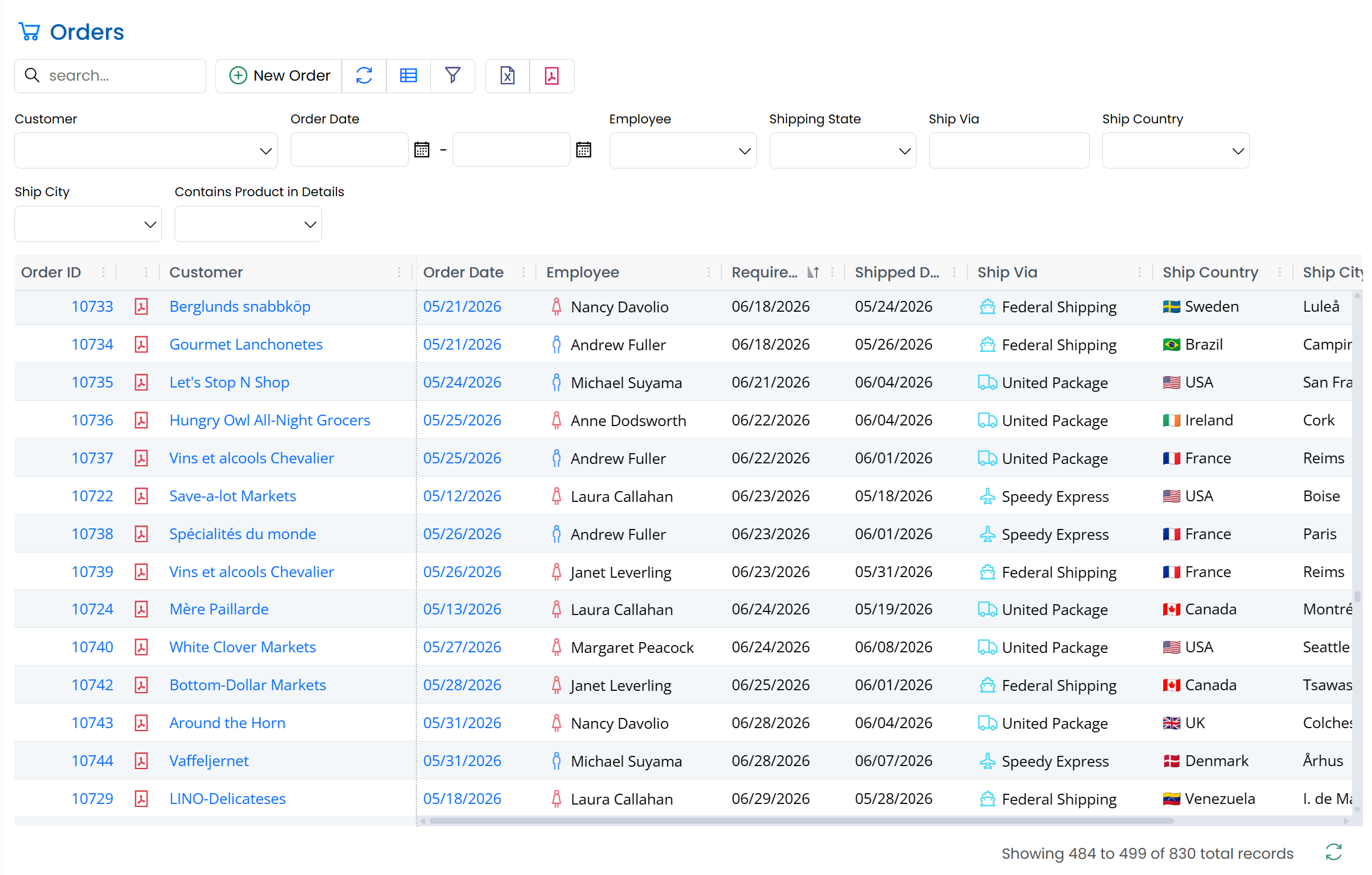
Infinite and Virtual Scrolling (StartSharp)
Two new views change how large grids paginate, both in Serenity.Pro.Extensions:
InfiniteScrollView / InfiniteScrollPager
Loads rows in chunks and appends the next chunk when the bound grid nears its last loaded row, so the grid scrolls continuously without page navigation. The pager shows a reload button and a loaded/total status (including indeterminate counts), preserves loaded rows and scroll position on refresh for the same query, deduplicates rows returned again, and keeps the server totals and aggregates from the initial request.
VirtualScrollView / VirtualScrollPager
Exposes a row for every row the request matches, while only loading the ones near the viewport. The scrollbar covers all rows, any row can be scrolled to without loading everything before it, and rows far from the viewport are released past maxLoadedRows (5000 by default) to be loaded again when scrolled to. Because not all rows are present, sorting, grouping and aggregation are done by the server; groups are listed even when none of their rows are loaded. loadDelay (50 ms by default) debounces requests while scrolling.
Under the Hood
RemoteView.page,totalCountandmoreare nowprotectedso a subclass can read and adjust the paging state. ExtractapplyResponse,setRequestPagingandkeepServerTotalshooks let a view that loads rows in another way (e.g. by appending) reuse the paging logic instead of duplicating it.RemoteView.addDatano longer aborts a request thatonProcessDatastarts itself (e.g. a grid that learns its columns from the data and then asks for summaries).onProcessDatanow runs after the loading state of the finished request is cleared, and cleanup only clears loading when it still belongs to the finished request.InfiniteScrollPageraccepts any view that can bind to a grid through the newScrollLoadingViewinterface, and its status range moved into an overridablegetRange.- The grouping helpers of
RemoteView(normalization, server group lookup, request sort/grouping/aggregate construction, group value formatting,groupingDelimiter,groupKeyText) are now public statics, so the same logic can be used without a view instance.
Indeterminate (Load-More) Paging
Counting every row is slow on large tables, so a grid can now ask whether more rows follow instead:
RemoteView.indeterminatePagingsendsIncludeMoreinstead ofExcludeTotalCount. The total count then reflects only the rows known so far, and an empty page past the end falls back to the last page that has rows.PagingInfo.indeterminate/PagingInfo.hasMoretell consumers that the paging is open-ended.SlickPager.indeterminatePaginghides the last-page button and the total pages, disables the next button when there are no more rows, and accepts any page number typed in.- The new
PagerTexts.RangeStatus("Showing to records") covers the unknown-total case and is translated for all locales.

Unified Server and Client Validation
A property now declares its constraints once, and both the browser and the save handler enforce them.
The Validate* Attributes
New attributes mirror the DataAnnotations ones but also describe themselves to the client:
| Attribute | Client rule | Implied message key |
|---|---|---|
ValidateRange |
Serenity.RangeValidationRule |
Field_ValidateRange |
ValidateLength |
Serenity.LengthValidationRule |
Field_ValidateLength |
ValidatePattern |
Serenity.PatternValidationRule |
Field_ValidatePattern |
ValidateEmail |
Serenity.EmailValidationRule |
Field_ValidateEmail |
ValidateUrl |
Serenity.UrlValidationRule |
Field_ValidateUrl |
ValidateCompare |
Serenity.CompareValidationRule |
Field_ValidateCompare |
They implement IClientValidationRule, so the rules travel to the form as PropertyItem.validationRules, and PropertyGrid attaches them to the editors through Validator.addCustomRule, skipping read-only and hidden fields exactly like the browser does. Messages are localizable by the implied key, or by an explicit TextKey, and the limits of a range are parsed and converted in the invariant culture. An empty value is always valid, as being required is RequiredAttribute's concern.
Custom Rules
ValidationRuleAttribute is the base of a custom rule that the forms also check. The client class is found by its type key (a Key constant of the attribute, or the convention ValidateEvenAttribute → MyApp.EvenValidationRule), the server typings generator imports it into the forms that use it, and a rule that implements LazyLoadInclude can be loaded on demand instead:
public class ValidateEvenAttribute() : ValidationRuleAttribute(Key)
{
    public const string Key = "MyApp.EvenValidationRule";
    protected override string DefaultTextKey => "Validation.Even";
    protected override bool IsValidValue(object? value, ValidationContext context) =>
        Convert.ToInt64(value, CultureInfo.InvariantCulture) % 2 == 0;
}
export class EvenValidationRule extends ValidationRule implements LazyLoadInclude {
    static override [Symbol.typeInfo] = this.registerRule("MyApp.");
    override textKey = "Validation.Even";
    override defaultText = "Please enter an even number.";
    check(value: any) { return Number(value) % 2 === 0; }
}
ValidationRuleTypeRegistry finds rules by their type key, so a rule can also be registered by a plain function. Rules that need to wait (for example for a query) override IsValidValueAsync (IAsyncValidationRule), which asynchronous save handlers await while synchronous callers still use the synchronous value.
Validating What the Form Checks
FormValidationAttribute makes the save handlers validate by a form, i.e. the checks the row itself doesn't have: the form's RequiredAttributes, RequiredWhenAttributes and validation rules, skipping the fields the form hides or makes read only. It can be on a save handler or on a row for the handlers that have none, and a handler can choose a form by overriding GetValidationForm when an entity has more than one form.
ValidationRules.ValidateObject runs that validation directly, and save handlers now have a service provider so a rule can reach the connection and the localizer.
Breaking change: ICustomValidator, IValidationContext / ValidationContext and RowValidationContext are replaced by the DataAnnotations-based ObjectValidator. Custom validators should become a ValidationRuleAttribute (plus a client-side rule class for the forms) or a plain ValidationAttribute.
Locale Coverage
The missing Validation.Compare, Validation.Invalid, Validation.Pattern and Validation.RangeLength texts were added to every locale plus the English fallback, so a rule message resolves to localized text instead of a raw key.
Conditional Form Fields
A field can now depend on the value of another field:
[VisibleWhen(nameof(Action), MyAction.OpenLink)]
[ReadOnlyWhen(nameof(IsSystem))]
[RequiredWhen(nameof(Action), MyAction.Save)]
public string? LinkAddress { get; set; }
VisibleWhen,ReadOnlyWhenandRequiredWhenarePropertyConditionAttributes; a property can have several of the same kind and they must all be met. No values means "has a value" ("checked", for a checkbox), andIsNotinverts the condition. A named rule is a one-liner:public class ForLinkAttribute() : VisibleWhenAttribute(nameof(Action), MyAction.OpenLink) { }.- The conditions are projected into
PropertyItemmetadata (visibleWhen,readOnlyWhen,requiredWhen,clearWhenHidden) and evaluated byPropertyGridwhen values load and change. Categories and tabs whose fields are all hidden are hidden too. clearWhenHiddensaves a value hidden by a condition as empty, so stale values don't come back when the field is shown again.- The shared helpers are used by both the server and the client, and the generated typings expose the new condition types.
Conditions are for forms only and are not a security boundary: a request can still contain a value for a field that is hidden or read-only, so permissions and the service still decide what is saved.
Static Assets Without the SDK
Serenity no longer depends on the .NET static web assets SDK for project and package wwwroot files. Serenity.Net.Web ships its own targets and serves, publishes and packs those files from a build output manifest:
var builder = WebApplication.CreateBuilder(args);
builder.WebHost.UseSerenityStaticAssets();
SerenityStaticAssets.targetscollects the files (SerenityStaticAssetIncludes/Excludes, with SDK-like default excludes and a whitelist option), writes[AssemblyName].serenitystaticassets.json, andPrefixedFileProviderserves them underStaticWebAssetBasePathor the assembly name. Publishing copies them towwwroot\[BasePath]\, and packing puts them understaticwebassets\with abuildTransitiveprops file for consumers.- The manifest also carries the publish include/exclude patterns, so files that would not be published or packed are no longer served (
StaticAssetPatternFilter,FilteredFileProvider), and the long default pattern lists are shared as pattern sets instead of being repeated per folder. - Eligible files are precompressed to
.br/.gzon publish (CompressStaticAssetsTask, cached in the intermediate output, Brotli only when MSBuild supports it, with a visible notice otherwise), and the host serves the matching variant withVary: Accept-Encoding. - The build tasks now ship compiled in the
Serenity.Net.Webpackage instead of being recompiled withRoslynCodeTaskFactory, andSERSA001/SERSA002warnings point out a referenced package or project that still needs the SDK (silence withSerenityStaticWebAssetsCheck). - The static asset manifest is now propagated reliably to referencing projects (e.g. a functional test project that needs the manifest next to its assembly) by resolving the roots in a
_ResolveSerenityStaticAssetsForContenttarget that runs beforeAssignTargetPathsinGetCopyToOutputDirectoryItems. - The TypeScript and
sergentransforms became incremental, with input lists and stamp files, so a rebuild only regenerates what changed.
Breaking change: projects must call UseSerenityStaticAssets() instead of UseStaticWebAssets(), or keep static web assets enabled. The Serene and StartSharp templates set StaticWebAssetsEnabled=false and call the new method. Projects that reference a package or project which still uses the SDK must set StaticWebAssetsEnabled back to true (or follow the SERSA001/SERSA002 warnings). wwwroot files are now None items instead of Content, so custom content rules may need adjusting.
Lazy Loading Types in Groups
Types that are only referenced by key — for example the editors of dynamically generated property items — can now be registered for lazy loading:
LazyLoadInclude(optionallyLazyLoadInclude<"Group">) marks a type, and code generation registers it inLazyTypeLoader.mtswith literal dynamic imports, so bundlers can split types into chunks. Types with the same group share a singleLazyTypeGroup.<Group>.tschunk instead of one chunk each.LazyLoadTypesAttributeandHtml.LazyTypes()render the content-hashed module URLs and their keys as JSON; both templates add it to the layout head.Config.lazyTypeLoaderis the default loader and can also answer availability checks without importing a module.QuickFilterBarandEditorFilteringaccept promise-like widget types with placeholders, preserving saved state, values and handlers until the real widget is ready.PropertyGrid.getEditorsLoading()returns a promise for the editors that are still loading (ornullwhen none are), so a caller can wait before saving, since a lazily loaded editor can't save its value until its widget exists.
The demo Northwind formatters and entity dialogs are now lazily loaded, with the eight dialogs sharing a single NorthwindDialogs group:
export const lazyTypeGroupNorthwindDialogs: Record<string, any> = {
    // ...
};
Inferred Keys for Forms, Columns and Enums
FormScript, ColumnsScript and EnumKey gained InferKey, so keys no longer have to be spelled out. With InferKey = true the key is derived from the [Module] attribute, the BasedOnRow type or the namespace, dropping the root namespace and the Forms / Columns segment and the Form / Columns / Request suffix:
[FormScript(InferKey = true)] // Serenity.Pro.Meeting.Forms.MeetingForm -> Pro.Meeting.Meeting
public class MeetingForm { }
A parameterless EnumKeyAttribute implies InferKey. The key resolution is shared, so the server typings generator, FormScriptRegistration, ColumnsScriptRegistration and PropertyItemsLocalTextRegistration all agree — previously a columns script could register itself under the full type name while its generated columnsKey used another form, and .Enums / .Lookups suffixes were stripped inconsistently. Note that Lookups keeps its namespace segment now, since only .Forms and .Columns are stripped by the convention.
The StartSharp pro feature modules (meeting, worklog, email client, data audit log) were migrated to inferred, shorter keys (Serenity.Pro.Meeting.Forms.MeetingForm → Pro.Meeting.Meeting), so regenerate server types and texts after updating and check any place that hardcodes a form/column key.
Attributes From Interfaces
A property now also receives the attributes declared on the members of the interfaces it implements:
GetPropertyAttribute/GetPropertyAttributesandWrappedPropertyresolve interface members, including intrinsic/combination attributes, and validation, property grids, row mapping, localization, reporting and server typings all use them, so shared interface properties behave like normal property items.- Precedence is unchanged: own and base attributes win,
AllowMultipleattributes from interfaces are appended, explicit interface implementations are ignored, and interfaces are ordered deterministically. - Combination attributes are now read from
CustomAttributesmetadata instead ofGetCustomAttributes, so their constructors never run during reflection. This fixes an infinite recursion when a combination attribute refers to its own row and reads its attributes in its constructor (e.g. aForeignKeyAttribute-based attribute). - Own attributes now win over intrinsic ones: an attribute set directly on a property is not shadowed by the same type exposed through a combination attribute, except for attributes that allow multiple instances (
Tag, for example). - The RowFields source generator applies the same resolution for
[IdProperty],[NameProperty],[Column]and[Size](StartSharp), so rows that get their id/name/column name/size from an interface generate the same code as the runtime resolves.
Behavioral change: generated field names, sizes and id/name interfaces can now change for rows that used interface-level attributes. Regenerate and review the diff.
Property Grid and Editor Improvements
Base property order.
BasePropertyOrderAttribute(BasePropertyPosition.Default/Before/After,TypesBefore/TypesAfter,WhenInherited) lets a type control where inherited properties appear in forms and property grids instead of relying on declaration order. It composes across multi-level hierarchies, and specific base types can be ordered before or after the type's own properties.Editor attribute templates. A custom editor attribute inherits defaults from an editor attribute declared on its class while explicit options still win. Service lookup templates only supply item type, endpoint type and action name when the attribute defines no endpoint, and lookup template options are copied into filtering (now including capabilities and quick search fields).
Generated editor defaults. The server typings generator emits
<Editor>Defaultsconstants for lookup and service lookup attributes with a template, resolving service/action, capabilities (as named enum members likeFilteringOptions | Sort | PagingOptions), id/text/icon fields and lookup keys the same way the server does.QuickSearchFieldsand a typedSort(string array) were added toServiceLookupEditorBaseAttribute, andSetServiceLookupParamsis public.BooleanEditorAttribute/BooleanEditorOptionsnow take theCheckLabelPositionenum:Start(default),End(checkbox first, caption after, several checkboxes per row) andEndAligned(likeEnd, but the caption area is left empty so a checkbox alone in its row lines up with the editors above). The CSS hides the end-aligned spacer in vertical forms and below 760px.ColorEditor(StartSharp) types a color as hex text (#d9e6ff,#d9e6ff80) orrgb()/rgba(), and opens aColorPickerPanelpopover from a swatch: a saturation/brightness area, hue and alpha sliders, hex/RGBA fields and an eyedropper.ColorUtilsparses and formats colors, converts RGB/HSV and computes readable text colors. The popup follows its swatch on scroll and resize, and both the editor and its texts are localizable.
DateRangeEditor(StartSharp) edits a range as text or from a flatpickr range calendar with predefined ranges that follow the current date, storing the range name when it has one so it stays correct as days pass.DateRangegained parsing, formatting and naming with localized names, plusPreviousStart/PreviousEnd/PreviousEndExclusiveparts for comparing with the previous period and anEndExclusivepart soOrderDate < @EndExclusivecovers the last day of a date-time range.
Select2 no longer masks the editor. The select2 container copied the input's classes, including
editor, and was inserted before the input, so any code looking up a field's editor found the container. It now adapts the class toeditor-likeviaadaptContainerCssClass: the container still gets the editor's width/layout styling, but no longer claims to be the editor.editor-likewas added to the readonly,.fieldand.input-grouptheme rules, and an editor wrapped in an input group with addons gets the same class so it lines up with plain editors.Validation icon in input groups. The error icon got
flex: 0 0 autoso it keeps its size, it is revealed when the error element is nested in an input group (.input-group:has(> .error)~.vx), and a field's input group now flexes and shrinks (flex: 1 1 0.01%,min-width: 0,width: auto) so it shares the row with the icon instead of pushing it out of view.
Grid and DataGrid Fixes (StartSharp)
- Cancelling a cell edit with Escape consumes the keystroke, so it no longer closes a containing dialog, and the keystroke stays within the grid.
- Drag plugins no longer intercept presses inside an open editor, which made text selection impossible.
- The active edit (column, row, item id, add-row flag and typed value) survives an auto save: it is captured before the save and restored afterwards, an item's new row is followed when the save reorders rows,
grid.refresh()is skipped while an editor is open, and the edit value is selected after loading so typing replaces it. - A column whose
maxWidthisnull,undefinedor0is treated as unlimited when autosizing. - Scrollbar thickness is measured from bounding rects and rounded up, and the cached dimensions are invalidated when
window.devicePixelRatiochanges, so a zoomed page no longer gets a spurious horizontal scrollbar.SleekGridre-checks the dimensions on every resize, not only when they are missing. - Header menu and header filter dropdowns are reparented into the closest modal or
document.body, so modal overflow and stacking contexts no longer clip them. ComboboxOptions.formatResultreceives the result, container andSelect2QueryOptionslike the Select2 formatter,CheckLookupEditor/ComboboxEditorunbind their cascade link on destroy, and a draggable grouping honors thecollapsedoption.- The local (in-process) service lookup no longer drops custom request properties that are not list request options: request keys are mapped to capabilities explicitly instead of being looked up by name in the capabilities enum, so unrelated option names are no longer matched and unsupported ones are still removed.
Enums, String Enums and Editors
Serenity.StringEnumstores a set as strings instead of numbers: cachedStringEnumInfo/StringEnumMemberlookups (name, value, text, visibility) andIsStringEnum,GetName,GetValue,GetValues,GetNames,IsDefinedandGetTexthelpers.StringEnumField<T>maps it to a string column and rejects JSON values that are not members through a newConvertJsonValuehook onStringField.EnumEditorAttributenow takes aTypeor an enum key, so a plain string property can use a set.EnumKey/IgnoreUIFieldwork on string enum members, local texts register under the usualEnums.<key>.<name>keys, and generated TypeScript is a const object plus a union type and aregisterEnumcall.EnumSelectFormatter,EnumEditorandRadioButtonEditorhandle string values instead of their numeric-only workarounds.- Flags.
registerEnumtakesenumFlags(emitted for[Flags]enums),Enum.toStringreturns a named member or the fewest members that make the value like .NET, andEnumEditorhas aflagsoption so a multiple editor stores the OR of the selected members and skipsNonewhile combined members exist.ServiceLookupEditorBaseAttributeeditsCapabilitieswith such an editor, andEnumJsonConverteraccepts any valid flags combination (includingulong-backed enums). - Icons. Enum members can declare
IconClass, emitted asenumIconsand exposed throughEnum.getIconClass.EnumEditor.mapEnum/mapIconhooks were extracted for subclasses, andColumnSelection/RetrieveColumnSelectionare registered under their server-side full names. SummaryTypeandAggregateTypemembers now use[DescriptionText], withEnums.*texts registered in the core and services resources for every locale.
SQL, Expressions and Migrations
Expressions
- New
Cast,Replace,SubstringandTrim/TrimLeft/TrimRightexpression attributes, translated for every supported dialect (SQL Server pre-2017TRIM, MySQL cast types, Oracle date truncation, SQLite type affinity, Firebird's missingLTRIM/RTRIM).TrimAttributeoptions areinit-only. DateAddwas added, andDateDiffnow counts the part boundaries crossed like SQL Server'sDATEDIFFinstead of complete units (SQLiteSTRFTIME, PostgreSQLDATE_TRUNC, OracleTRUNC, MySQLDATE_FORMAT), with end-of-month dates clamped for month/year addition.RegexWithDefaultcombines regex patterns, so a default pattern can be extended instead of replaced.- Fixed
SqlDateTimeOffsettranslations (PostgreSQLCURRENT_TIMESTAMP, SQL ServerSYSDATETIMEOFFSET()) andSqlUtcNownow uses Firebird 4 time zone support. Oracle parameters are bound by name (BindByName) so repeated or reordered expression parameters get the right values, and single parameters are cast for Firebird inDatePartandConcat. - Oracle
CONCATis no longer wrapped inCOALESCE(..., ''): Oracle'sCONCATonly returns null when both arguments are null and an empty string is already null there, so the wrapper was redundant — and it failed with a character set mismatch forNVARCHAR2arguments.
Collations and Databases
SqlCollationSpec/SqlCollationMappertranslate ordinal, invariant and culture comparers with case/accent options into engine-specific collation names. The connectionCollationacceptsautomap,tryautomapandtolerantkeywords (plusIgnoreAccents) and resolves them from the connection'sComparer.EnsureDatabasetakes an optional collation (SQL Server/MySQL/FirebirdCOLLATE, PostgreSQLTEMPLATE template0with locale or ICU, rejected for SQLite and Oracle), defaulting to the connection's collation, withPartialContainmentsupport and noCOLLATE/CONTAINMENTwhen attaching existing SQL Server files.MapCollation/TryMapCollationmigration helpers were added, andMigrationUtils.ClearAllPoolsclears only the migrated database's pools instead of every pool in the process.
Migrations
- Dimensioned tags.
MigrationTagUtilsgroups tags by the part before the:and requires every declared dimension to match, while keeping FluentMigrator's RequireAny/RequireAll rules within a dimension. Thedb:dimension is a partition: a migration runs when any of its databases is requested, and legacy tags likeDefaultDBnormalize todb:Defaultonly when that database is requested. Anenv:Stagingtag is therefore a real gate now. AssignMigrationTagUtils.CreateMatcher()toIMigrationRunnerConventions.TypeHasMatchingTagsand useTargetDBAttribute, which declares both forms. - Sample data.
SampleDataAttributegates sample migrations behindsample:Allor a per-module tag such assample:Dashboards. - Non-integer user IDs.
UserEntityOptions.SystemUserId(withGetSystemUserId/HasIdentityUserId) is the user that system-created rows are attributed to; it defaults to1forInt32/Int64IDs and must be set forGuid/StringIDs. The initial migration creates the Users table with a plain primary key when user IDs are not database-generated. - Migration edge cases were fixed: a raw
ALTER TABLEon Oracle when setting an already nullable column, the oversized compositeFileSystemindex skipped on Firebird, the Oracle concurrency version trigger executed throughWithConnection(FluentMigrator's splitter cuts PL/SQL blocks), identifiers quoted through the dialect, Firebird identity generators reset after seeded rows, and provider-specific SQL matched by prefix so versioned dialect names likePostgres15_0are not silently skipped. - Additional SQL types are mapped for schema generation (
boolean,bytea,double precision,json,jsonb,uuid) andDateOnlyvalues are handled when reading and convertingDateTimefields, since providers like Npgsql returnDateOnlyfor date columns.
Users, Roles and Login
IUserListService/IRoleListServicewithBaseUserListService/BaseRoleListService, so pickers can list users and roles while selecting only what a list item needs — nothing like a password hash is loaded. Ids and usernames are chunked to stay below parameter limits, normalized usernames are used when available, and users requested by id or username are listed whatever their state. Register withAddUserListService/AddRoleListService.IRoleKeyRowandGetKeyOrName, so renamed roles keep a stable key for the permissions stored against them.- Normalized username and email.
INormalizedUsernameRow/INormalizedEmailRowandBaseUserRetrieveService.NormalizeUsername/NormalizeEmailcompose Unicode and fold case (including Turkish ı/İ), so username and email lookups no longer depend on the database collation. The Serene and StartSharp templates addNormalizedUsername(unique, not null) andNormalizedEmail(indexed) columns with backfill migrations that use the SQL equivalent of the normalizer, keep them in sync in user save, sign-up and LDAP sync, and use them for duplicate checks and login throttling.
Security and Request Hardening
- Retrieve, list and list-Excel actions of the Northwind demo modules, the Serene administration endpoints and the StartSharp/pro-features endpoints now have
[HttpPost]plus[AuthorizeRetrieve]/[AuthorizeList], so read operations enforce the same row-level permission checks as the rest of the CRUD surface and can't be triggered by other verbs. TheFileExplorerendpoint gotServiceAuthorize, and the Data Explorer list and translation endpoints got[HttpPost]. Do the same in your own endpoints. - Data Explorer (StartSharp) now applies its default table exclusions to every connection (
UseDefaultExcludeTables, true by default), addsExcludeTablesRegexto the default pattern instead of replacing it, matches sensitive tables with or without a schema prefix and case-insensitively, and also hidesDistributedCache,FileSystem,dsrc_*anddash_*tables. - Potentially sensitive field names are exposed as a reusable list, which the dashboards default protect rules use for columns.
- SQL type mappings in Data Explorer were expanded for Oracle (
varchar2,nvarchar2,number,clob,nclob,raw,long raw,rowid,urowid,binary_float,binary_double,timestamp with local time zone,xmltype,bfile), PostgreSQL (uuid,json,jsonb,bytea,boolean,double precision), MySQL (longtext,mediumtext,tinytext,blob) and DB2 intervals, including stream- and byte-backed types.
Caching, Navigation and Translations
- Two-level cache entries can depend on several cache groups through new
Get/GetLocalStoreOnlyoverloads taking group key lists, so an item expires when any of its groups changes. Single-group entries stay compatible. NavigationCaching.ItemsGroupKeywas added, and the navigation model depends on both the permission generation key and that key, so navigation items are rebuilt when the item group changes and sources can invalidate items without knowing the factory's cache details.IDynamicLocalTextSourceregisters texts kept in application data at initialization time (after base and JSON texts, and again after texts are reset), andITranslationKeyProvidersurfaces such keys (e.g. dashboard titles) on the translation page, reporting only keys and their source texts. StartSharp's translation list merges provider keys with the registry.- The JSON texts generator now tracks out-of-date translations: it maintains a
*.texts.__.stale.jsonnext to each texts folder with the English text a translation was made for, the current English text, and the translations that still look like the old ones. Old translations stay in the language files (an outdated translation still beats English) and entries are dropped once the translation changes, the English text returns, or the key disappears — the file is deleted when nothing is left, so the list only shows work that is still needed. - Translations are carried over for renamed keys: if a key disappears and a new key has the same English text, the orphaned translation is reused, preferring candidates whose last key segment matches and skipping ambiguous ones or translations that would drop a
{0}–{2}placeholder. - The json texts generation can now run from the CLI, and the tool buttons stay hidden on translation exit.
Tooling: Testing, Code Generation and Release
Serenity.Testing and Serenity.Testing.Playwright
The test infrastructure was extracted from the framework tests into two reusable packages:
Serenity.Testingwith the shared mocks, null mocks, test rows and in-memory SQLite helpers. Breaking: the namespace is nowSerenity.Testing, notSerenity.TestUtils.ISerenityTestApp/FunctionalTestContext<TStartup>boot an application in-process on a random HTTPS port with an in-memory database, snapshots, test login endpoints and configurable test users, so browser tests need no external service.Serenity.Testing.PlaywrightwithFunctionalTestBase, page objects for dialogs, grids and inputs, and auth, AJAX and failure-artifact helpers.
Code Generation
- Basic types extend corelib base classes. A project's basic type now extends the nearest base class from a
Serenity.Netassembly that corelib has a type of the same name for (e.g.PropertyItem) instead of repeating that base class's members. Generic base types and enums are skipped, project base classes still list their members, and the walk stops atSystem.Object. - The server typings generator emits
*.mtsfiles and now deletes stale*.mtsalongside*.ts, so renamed or removed ESM typings don't linger.ESMAssetBasePathis forwarded to the client types generator so generated types reference ESM assets at the configured path. - Pro.Coder (StartSharp) server typings generation skips the expensive full diagnostics scan when the run would not delete stale outputs, keeping the cheap unresolved-attribute-symbol check and deferring full compile diagnostics behind a memoized fallback. The guard reports stale outputs by listing the output directory against the files about to be written.
builtin-ts-typesis a new script (also available at the StartSharp root) that builds the corelib and sleekgrid.d.tsfiles and regenerates the builtin type model. The generator test is now an explicit[Fact]and locates the repository root by walking up fromAppContext.BaseDirectoryinstead of relying on a/Serenity/path segment.sergenwarns when the running tool version differs from the project'sSerenity.Net.Webversion, and refusesmvc,clienttypesandtransformwith the newGeneratedOnBuildexit code (14) when the project's Pro.Coder generators already produce those files during build (--forceoverrides).
Release CLI (StartSharp)
The Cake/chained-.cmd release flow was replaced by Serenity.Release, driven by release.ps1 (it hashes its own sources and runs the built DLL directly, so later runs start in well under a second, and -Rebuild forces a build):
- A resumable pipeline with a journal:
release statusreads the journal of a run per step, and only completed steps are skipped, so a failed release continues where it stopped. - Steps for version bumps (scoped to selected steps), packaging and publishing to NuGet and npm, building all feature repositories, template builds and smoke tests, changelogs and release notes, framework and API docs (C# and TypeScript), committing/pushing/tagging the repositories, and
github:releaseto create a draft GitHub release from the changelog section viagh. release verify <version> [--wait N]checks the NuGet and npm feeds, git tags, GitHub releases, Marketplace, docs and demo URLs.- Step output is colorized consistently in the live renderer and in
release status, a missing journal is reported in yellow, and the release id is printed as a bracketed cyan header.
Build
- Package versions are centralized in shared props files (
Package.Version.props), so packages can't drift out of sync and the version is bumped in one place. allwas split intoall:notestsplus the test suite, so the full pipeline stays one command while everything except tests can run on its own.- Package versions can be overridden from the command line, the build fails fast when a
package.jsonpatch is missing, and prepack (not publish) runs the build and dts steps. - Shared build sources get implicit usings (
System,System.Collections.Generic,System.Linq,System.Text.RegularExpressions), no longer need explicitusingdirectives, and stale resource files are excluded from embedding. - StartSharp's pnpm catalog was refreshed,
@types/nodeis pinned to a single version with a workspace override (duplicate copies madetscreport every Node global as a duplicate declaration), and@tiptap,vite,vitest,jsdom,preact,dompurify,bootstrap,daterangepicker,fullcalendar,datatables.netandgridstackwere bumped.
Localization
A large batch of translation fixes went into the framework, the common features and the pro features:
- Strings that were cut off mid-word were restored (progress dialog cancel/wait text, bulk action success format, clipboard copy messages, password reset messages), along with missing trailing punctuation and placeholder markers (
All,ThenBy,ClickToDefine,NoResultsClickToDefine). - Untranslated and wrong strings were fixed: the Dutch
NothingToProcess(which was reduced to a bare "Selecteer "), the RomanianInvalidResetToken, the ItalianWorkLog.NotAnEmployee(which was null), theControls.ImageUpload.ColorboxCurrentplaceholders ({current}/{total}), and the role key placeholder, which now explains that the value is used as a special permission key (Role:RoleKey). - Sign-up success and activation-complete messages now tell users to check their email and log in with the registered credentials,
FailedScanpoints at https://serenity.is/docs/av, andValidation.EntityNotFoundgot its missing exclamation mark. - Terminology and grammar were improved in Turkish (Kimliği instead of ID, Kişi/Düğme/Simge, dialog boxes, password and permission wording), German, Spanish, French (typographic apostrophes), Bengali, Farsi, Korean, Indonesian, Russian, Vietnamese and Chinese (full-width punctuation), and page titles were aligned with their permission names in several locales.
- The Northwind demo translations were repaired (truncated phone validation messages, missing closing quote, untranslated "Reorder Level" labels, the missing Italian
CustomerDetailslabel), and so were the basic sample texts. - The two-factor authenticator prompts no longer contain stray newlines, tabs and repeated spaces.
Northwind Demo and Sample Data
NorthwindSampleDates.Shiftis a dialect-aware helper that moves the seeded sample orders andCustomerDetails.LastContactDateto the present usingDateAdd. It only touches orders up toLastSampleOrderId(11077), so orders entered by users afterwards are untouched, it is idempotent (when the latest order is today or later it does nothing), null dates stay null, and it callsEnsureOpen()since it runs outside Serenity's helpers. StartSharp runs it during startup migrations only when sample data is requested, so dashboards showing the last 30 days are not empty; a failure is logged to stderr instead of aborting startup.- The Northwind entity dialogs are lazily loaded as a group, and the demo Northwind declarations implement
LazyLoadInclude<"NorthwindDialogs">. Employee.Photois markedNotMappedso the stream property is not treated as a persisted column.
10.6.3 (Patch Release)
Between 10.6.2 and 10.7.0 there was one patch release. Nothing in it requires application code changes, and there were no skipped versions in between:
- TypeScript 7 compiler.
Microsoft.TypeScript.MSBuildis pinned to7.0.1instead of the floating[6.0.3,7.0.0)range, so projects created from the Serene and StartSharp templates build with the TypeScript 7 compiler. Existing projects keep restoring the 6.x compiler from their own reference until they update it. sergen doctorfalse warnings. The Serenity-to-@serenity-is/tsbuildversion table is now a minimum required version instead of an exact one, so Serenity patches without a matching tsbuild release no longer fail the check, and a newer tsbuild version only warns when its minor version is ahead. The recommended version comes from the npm registrylatesttag when it is newer than the last table entry and the project's Serenity version is at least as new, falling back to the table when the registry is unreachable.- Package updates:
Microsoft.Extensions.*,System.Text.Json,System.Security.Cryptography.Pkcs,Microsoft.AspNetCore.DataProtectionandMicrosoft.Data.Sqliteto 10.0.14, MailKit 4.18.2, Markdig 1.5.0, NUglify 1.23.5, Scriban 7.5.3, PuppeteerSharp 25.15.0 andMicrosoft.Playwright.Xunit.v31.64.1. - Packaging and tooling:
@serenity-is/dtsbundler0.2.0, the build and dts steps run in prepack instead of publish, build-only mode skips the sergen update, boolean switches are supported byArgumentReader(defaulting to true), package versions can be overridden, and theallscript was split into build and test steps.
Package Updates
Notable NuGet updates in 10.7.0 (these come with breaking API changes in the affected libraries):
- MailKit 5.0.0 —
EmailSendernow passes the message through aMailKit.SendRequestinclient.Send, since the old overload was removed. StartSharp's email fakes were reworked for the new interface surface (Enable/EnableAsync,CreateIdleSession,SetQuota, multi-UIDExpunge/CopyTo/MoveTo, annotation store overloads, async disposal,ISendRequest/SendResult), andHtmlPreviewVisitorloads and converts TNEF messages instead of callingExtractAttachments. - MySqlConnector 3.0.0,
NuGet.Packaging/NuGet.Protocol8.0.0,System.IO.Abstractions.TestingHelpers23.0.0. Microsoft.Data.SqlClient7.1.2,Microsoft.Build.*18.12.2,Microsoft.Extensions.*/System.Text.Json/DataProtection10.0.15, Markdig 1.6.0, NUglify 1.23.7, Scriban 7.6.1, OpenIddict 7.9.0,Oracle.ManagedDataAccess.Core23.26.401, PuppeteerSharp 25.17.1, SkiaSharp 4.156.1.- npm: preact 11.2.0,
@preact/signals-core1.14.5, dompurify 3.4.18, bootstrap 5.3.9,@tiptap3.34.0, fullcalendar 7.1.5,datatables.net-bs53.1.5, gridstack 14.1.0, daterangepicker 4.0.2, vite 8.3.8, vitest /@vitest/coverage-v85.1.0, jsdom 31.0.1, es-module-lexer 3.0.5, and the CodeMirror SQL editor packages for dashboards. - daterangepicker 4 hides its calendars when
rangesis set, so the dashboard date range picker passesalwaysShowCalendars.layoutFillHeightValuefalls back to the inline height when the computed height is not a number, as detached nodes and jsdom have no layout box.
Upgrading to 10.7.0
Update NuGet and npm packages to 10.7.0 (StartSharp samples reference
Serenity.*10.7.0). StartSharp packages use the four-part10.7.0.0version, which shows as10.7.0.Static assets. Replace
UseStaticWebAssets()withUseSerenityStaticAssets()inProgram.cs(or keep static web assets enabled). SetStaticWebAssetsEnabledback totrueif a referenced package or project still uses the SDK, and readSERSA001/SERSA002to find them. If you have custom content rules forwwwroot, note that those files areNoneitems now.Validation. Migrate custom validators from
ICustomValidator/IValidationContext/RowValidationContexttoValidationRuleAttributeplus a client-sideValidationRule(or plainValidationAttributes). Add[FormValidation(typeof(MyForm))]to save handlers that should enforce a form's rules server-side, and check that yourValidate*messages resolve (the implied key isField_ValidateRangeand friends).List capabilities. Use
ListRequestCapabilities.ListHandlerorProListHandlerinstead ofAllorBaseline. If you wrap list responses yourself, note that theIListResponsemembers (TotalCount,More,Entities, ...) are now settable, andListResponse<T>.Entitiesconverts any assignedIListinto aList<T>. CustomRemoteViewsubclasses that declared their ownpage,totalCountormoremembers must drop them, as the base members are nowprotected.Keys. Add
InferKey = trueto new forms/columns (or leave keys explicit), regenerate server types and texts, and review the diff for shorter pro feature keys (Pro.Meeting.Meetinginstead ofSerenity.Pro.Meeting.Forms.MeetingForm). Update tests or code that hardcodes form/column keys.Interfaces and attributes. Regenerate the row fields and server typings so interface-level
[IdProperty],[NameProperty],[Column]and[Size]attributes are applied, and review the generated diff, since column names and field sizes may change.Lazy loading. Add
@Html.LazyTypes()to your layout head (both templates have it) if you mark types withLazyLoadInclude, otherwise their modules never reach the browser. Where a lazily loaded editor can be saved, wait forPropertyGrid.getEditorsLoading()before saving.Database migrations. Run the migrations for the normalized username/email columns, the dimensioned migration tags (
db:/sample:) andUserEntityOptions.SystemUserId. SetSystemUserIdexplicitly if your user IDs areGuidorstring. Review the Data Explorer exclusions if you rely on seeing internal tables.Dashboards (StartSharp Enterprise). If you create projects from the template, the
Dashboardsoption is enabled by default and adds theDataSources:SqlDataConnectorblock. For existing projects, add theSerenity.Pro.Dashboardspackage, configure the connection keys, permissions and access rules, includeNavigationCaching.ItemsGroupKeyin the navigation cache group keys, and optionally useIDefaultDashboardSelectorin your home page.Tests. Reference
Serenity.Testing/Serenity.Testing.Playwrightand changeusing Serenity.TestUtils;tousing Serenity.Testing;.CI and release scripts. If you generate code on build, check the new
GeneratedOnBuildexit code (14) ofsergenand thesergenversion warning.